Sale
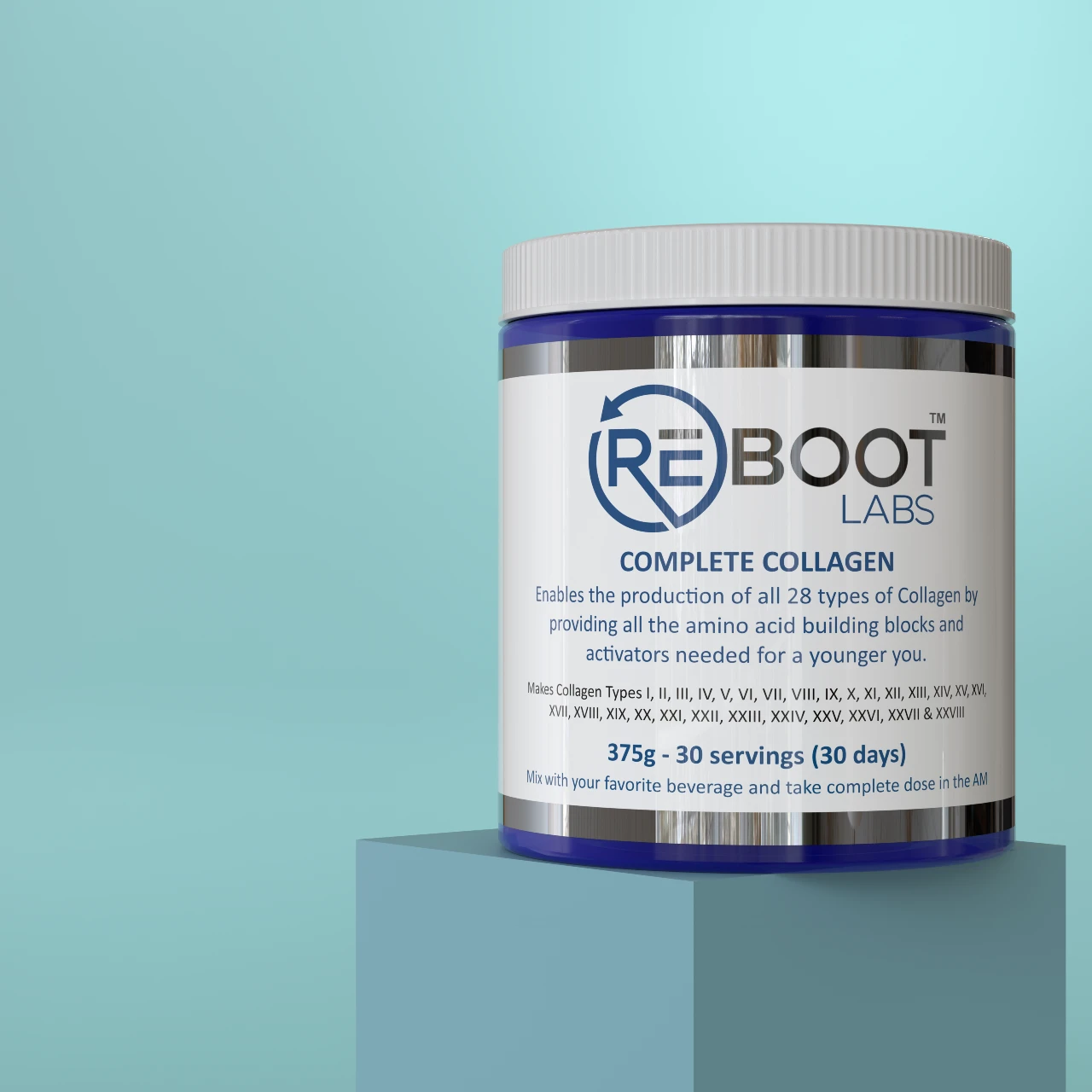
 Complete Collagen
Join Our Newsletter
No products in the cart.
$65.00 Original price was: $65.00.$55.00Current price is: $55.00. every month
$145.00 Original price was: $145.00.$130.00Current price is: $130.00. every 3 months
Unlock total body rejuvenation with the only supplement fueling all 28 collagen types for unmatched skin, joint, bone, and organ support that conventional single-type formulas can’t match.
Complete Collagen
$145.00 Original price was: $145.00.$130.00Current price is: $130.00. every 3 months
Introduction – Human Collagen Levels and Aging
Collagen is the most abundant protein in the human body, playing a crucial role in the structure and function of skin, bones, muscles, tendons, and ligaments. It provides strength, elasticity, and support to various tissues, making it essential for maintaining youthful and healthy skin as well as overall youthful physical integrity.
While aging naturally reduces collagen, this process can be reversed by Reboot’s Collagen Complete. Simply supplementing with generic collagen is not as effective as it usually only provides 2, 3 or 5 of the 28 collagen types.
Reboot’s Collagen Complete provides the body with a full slate of amino acid precursors and activators so that the body can produce all of the 28 types of collagens needed in the human body and truly reverse the effects of collagen loss during aging.
Collagen Production and levels in the Human Body
There are at least 28 types of collagens produced naturally by 44 different specialized cells called fibroblasts. Production is highest during childhood and adolescence, supporting rapid growth and tissue repair. Collagen levels peak in early adulthood. Starting in the mid-20s, the body’s collagen production starts to gradually decline. This reduction accelerates with age, and by the age of 40, the body may lose 1% to 1.5% of its collagen each year. Factors such as genetics, diet, sun exposure, smoking, and environmental pollutants can further accelerate collagen degradation.
Effects of Collagen Loss During Aging
• Skin Changes: Reduced collagen leads to wrinkles, sagging, and thinning skin. The skin loses its firmness and elasticity, making signs of aging more apparent.
• Joint Health: Lower collagen levels can result in stiffer joints and reduced cartilage integrity, increasing the risk of osteoarthritis and joint pain.
• Bone Strength: Collagen loss affects bone density and strength, contributing to conditions like osteoporosis.
• Muscle Mass: Collagen supports muscle structure. Its decline can lead to decreased muscle mass and strength over time.
• Other Tissues: Blood vessels, gums, and organs also rely on collagen; loss can lead to increased fragility and health issues in these areas.
| Collagen Type | Primary Locations in the Body |
| I | Skin, bones, tendons, ligaments, cornea, dentin, organs (e.g., heart, kidney, liver, lung), blood l ll |
| II | Hyaline cartilage (articular, intervertebral discs), vitreous humor of the eye; predominant in tilg |
| III | Skin, muscles, blood vessels (arteries), organs (e.g., uterus, bowel, lung); often alongside Type I in reticular fibers |
| IV | Basement membranes (all tissues, e.g., skin, kidney glomeruli, lung alveoli, lens capsule); forms sheetlike networks |
| V | Placenta, cornea, skin (interstitial), hair, bone, blood vessel walls; often co-assembles with Type I |
| VI | Ubiquitous in interstitial tissues; microfibrils connecting cells to matrix (e.g., muscle, skin, nerves) |
| VII | Dermal-epidermal junction (skin); forms anchoring fibrils below basement membrane. |
| VIII | Endothelial cells; cornea, blood vessels, some basement membranes. |
| IX | Cartilage (associated with Type II fibrils), intervertebral discs, vitreous humor; FACIT collagen on fibril surfaces |
| X | Hypertrophic cartilage (growth plates), bone mineralization zones. |
| XI | Cartilage (with Type II), tendons, trabecular bone; regulates fibril formation. |
| XII | Soft tissues (e.g., tendons, ligaments, skin, perichondrium); FACIT on Type I/II fibril surfaces. |
| XIII | Transmembrane; skin, neuromuscular junctions, placenta, brain. |
| XIV | Skin, tendons, cartilage; FACIT regulating fibril diameter. |
| XV | Basement membranes, placenta, kidney, heart; multiplexin (related to XVIII). |
| XVI | Skin (dermis), cartilage, fibroblasts; FACIT in many tissues. |
| XVII | Hemidesmosomes in skin (epidermis); transmembrane in epithelial tissues. |
| XVIII | Basement membranes (e.g., liver, kidney, lung); source of endostatin (anti-angiogenic). |
| XIX | Basement membranes, muscle, brain (hippocampus); rare FACIT. |
| XX | Cornea, cartilage, tendon, skin; FACIT. |
| XXI | Blood vessel walls, stomach, kidney; FACIT. |
| XXII | Tissue junctions (e.g., myotendinous, hair follicle); FACIT at interfaces. |
| XXIII | Transmembrane; heart, retina, metastatic tumors. |
| XXIV | Bone, cornea; fibrillar in developing tissues. |
| XXV | Brain neurons; transmembrane (related to amyloid). |
| XXVI | Testis, ovary; limited expression. |
| XXVII | Cartilage, liver, developing tissues; fibrillar. |
| XXVIII | Peripheral nerves (Schwann cells, dorsal root ganglia), skin, calvaria; neuronal tissue |